


A buyer moves in on a Saturday, runs the dishwasher, and finds water pooling under the kitchen floor by Sunday night. By Monday morning, the seller’s phone is ringing. That call, and whether it turns into anything, is the question sitting under this entire article: once the deed transfers, do repairs stop being your problem? The short answer is mostly yes. A few exceptions matter a lot if you land in one of them.
What Repairs Is a Seller Legally Required to Disclose Before Closing?
States with stronger caveat emptor traditions include Alabama, Georgia, Virginia, and Wyoming. Even in those states, deliberately concealing a known defect can land you in a lawsuit.
Disclosure forms are where your duty lives. California, Texas, Michigan, Ohio, Illinois and many other states make you put known issues in writing, usually on a state-approved form. These forms ask about the roof, the plumbing, the heating and cooling systems, past water intrusion, and prior repairs you’ve paid for. Answer them honestly, even when honesty feels like it’s costing you money.
You’re not expected to tear open walls or hire an inspector on your own dime before listing.
Where sellers get into trouble is the gray middle: the leak you patched twice and hoped was done, the crack you painted over, the heaters that never quite kept up in January. An “as-is” clause shifts the risk of unknown defects to the buyer. It signals you won’t be doing pre-closing repairs or giving credits. Still, it won’t protect you at all for deliberate silence or active concealment of known latent defects.
A buyer who knows about the sewer line before closing negotiates. Someone who discovers it afterward hires an attorney. The second conversation costs you ten times what the first one would have. Pennsylvania spells this out in statute. Its Real Estate Seller Disclosure Law requires residential sellers to disclose all known material defects before the sale agreement is signed. The broader principle holds in most states regardless of what the local form is called.
How Do You Prevent Repair Disputes Before Closing on a House?
Vague contract language starts more of these fights than anything else I see. It’s entirely preventable at the kitchen table.
Write the repairs down with specificity. Not “seller to repair roof,” but which section, by whom, to what standard, with receipts delivered by what date.
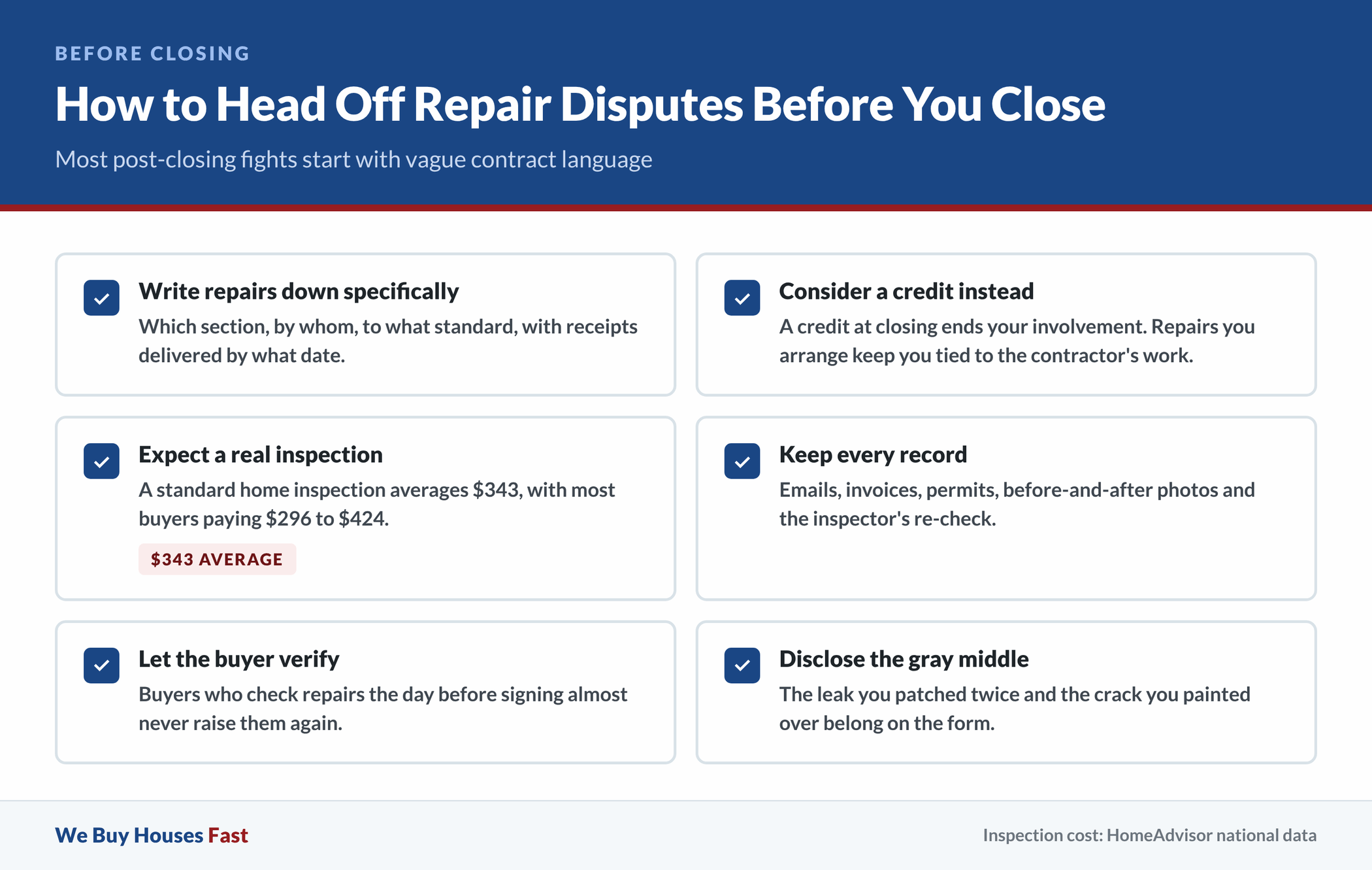
Should you hand over cash instead of handling the repairs yourself? Often, yes. A credit at closing ends your involvement cleanly. Repairs you arrange keep you tethered to the quality of a contractor’s work after you’ve handed over the keys.
Real scrutiny is what buyers are paying for these days. HomeAdvisor’s national data puts a standard home inspection at $343 on average, with most buyers paying between $296 and $424. For that money, buyers get a document that’ll drive every conversation about repairs you have.
A couple of years ago I bought a house in Lewisville, Texas from a family with five weeks to be out ahead of a job transfer. Their listing had already died once over a crawl space moisture report. The second buyer’s lender wanted repairs done before funding. We skipped negotiating repairs altogether and closed on their timeline. Boxes were still stacked in the garage next to a canoe they decided to leave behind.
Keep every email. Save the invoices, the permits, the before-and-after photos, the inspector’s re-check. Documenting repairs rarely drags sellers into anything later, because paper beats memory in every dispute I’ve watched unfold.
Buyers who verify repairs the day before signing almost never raise them again afterward.
What Happens If the Seller Doesn’t Complete Repairs Before Closing?
Now what?
At that point the buyer has leverage, and the contract usually spells out exactly how much. Unfinished repairs can delay closing, trigger a price reduction, or give the buyer grounds to walk with their earnest money. Lenders make it messier, too, since FHA and VA loans often require certain health and safety repairs to be completed before the loan funds at all.
An escrow holdback is the usual way to handle repairs that can’t be finished in time. Money gets set aside at closing, the work gets finished afterward, and the funds release to whoever earned them.
Walking away from a sale over unfinished repairs is rarely the right move for either side. I’ve watched sellers regret it once the next buyer’s inspection turns up the same issues. Right now, the market isn’t rewarding do-overs. Existing-home sales dropped 5.5% month over month in October 2026 to an annual pace of 3.75 million, according to the National Association of REALTORS®. Realtor.com’s October report showed 20.5% of active listings with a price cut, the highest October share since 2022. Relisting after a collapsed sale means more days on market and a weaker negotiating position than you had before.
Sellers who can’t finish repairs have a legitimate third path: they can just stop trying. Direct buyers take houses in current condition, which removes the repair contingency from the equation. Companies like We Buy Houses Fast buy without asking for repairs. For a seller staring at a contractor backlog and a hard moving date, that tradeoff can pencil out.
Is the Seller Responsible for Any Repairs After Closing?
Once that deed records, the house belongs to somebody else, and so do its repairs. I say that to sellers plainly because the worry keeps people up at night for no reason in most cases.
You sold a building with a history, not a product with a guarantee.
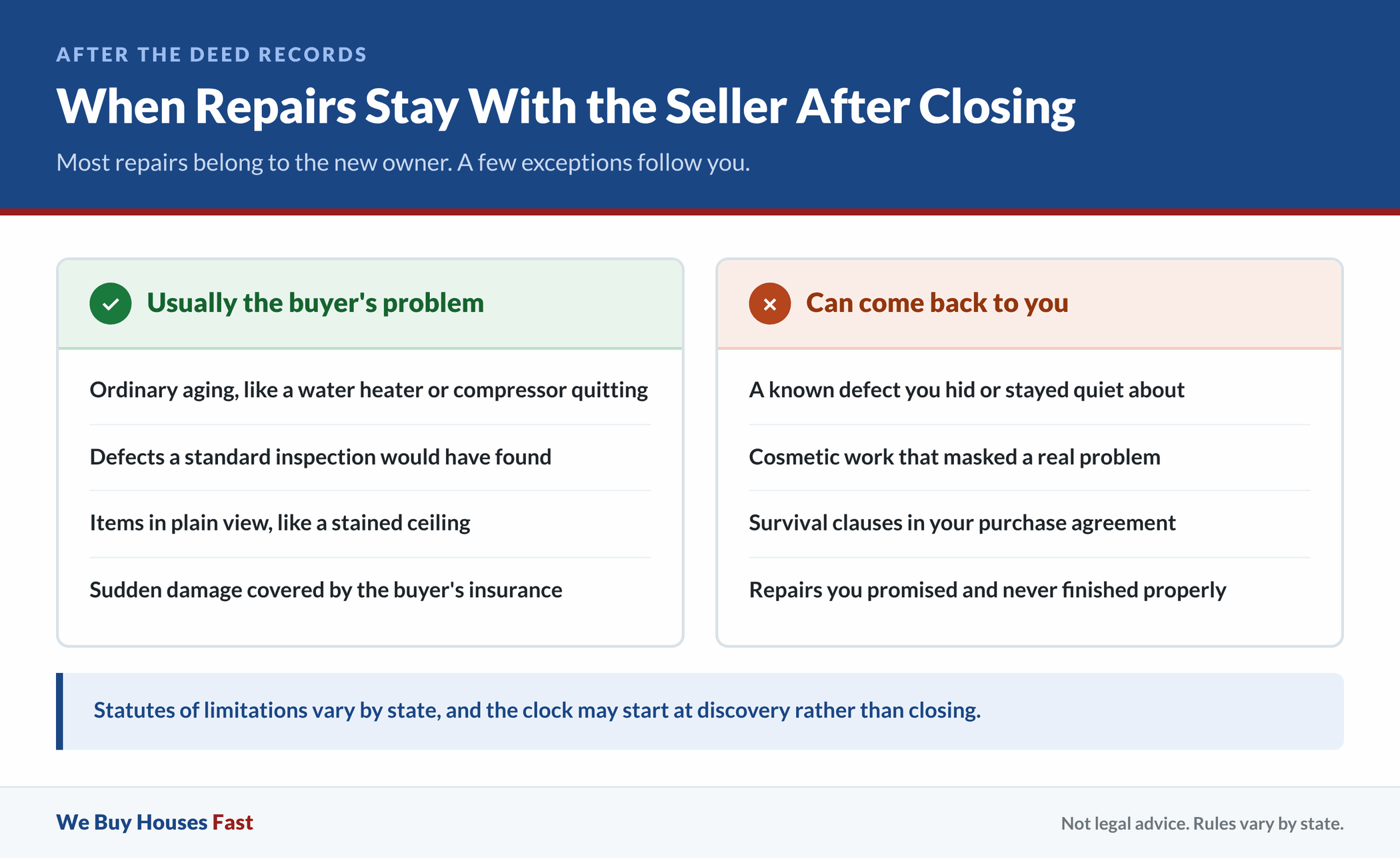
Two exceptions keep a seller on the hook. Fraud is the first. A seller who knew about a defect, had a duty to disclose it, and stayed quiet can be held liable for repairs long after closing. Florida’s Supreme Court held that caveat emptor doesn’t apply when a seller knows about a material defect a buyer can’t reasonably discover. Liability in that case survives the deed transfer. New Jersey courts reached similar ground: sellers there have a duty to disclose latent defects regardless of any “as is” language in the sale agreement.
Second, some sales contracts include survival clauses that keep specific representations alive for a defined period after closing. Read yours. Your attorney can tell you in ten minutes whether you signed up for post-closing exposure on repairs. Those ten minutes are well spent before you sign anything.
Statutes of limitations on these claims vary by state, and the clock may start at discovery rather than closing. Your own legal counsel or state real estate commission can give you the window that applies where your property sits.
Who Pays for Repairs Found After You Close on a House?
Non-disclosure claims generally require a latent defect, because a seller isn’t liable for failing to disclose something a standard inspection would have found. A stained ceiling, a cracked driveway, a thirty-year-old water heater in plain view: those don’t come back to you.
When a latent defect surfaces, courts often presume the seller knew about it, and the burden can shift to the seller to prove they couldn’t have known.
Most post-closing repairs land on the new owner anyway, because most breakdowns are just the ordinary aging of a house. Water heaters fail and compressors quit, with nobody causing it and nobody hiding it.
A buyer’s policy covers sudden damage from fire, hail, or a burst pipe, though it won’t touch a worn-out system that simply reached the end of its life.
Buyer expectations tend to run ahead of reality here: a house priced at the October 2026 national median of $416,700 is usually decades old and carries decades of wear. Buyers who treat a used home like a new one come into closing already set up for disappointment. That disappointment often gets pointed at the seller who had nothing to do with it.
Can You Sue a Seller for Repairs After Closing?
The seller’s disclosure form said no water intrusion, ever. That gap between the paperwork and the plywood is what turns a bill for repairs into a lawsuit.
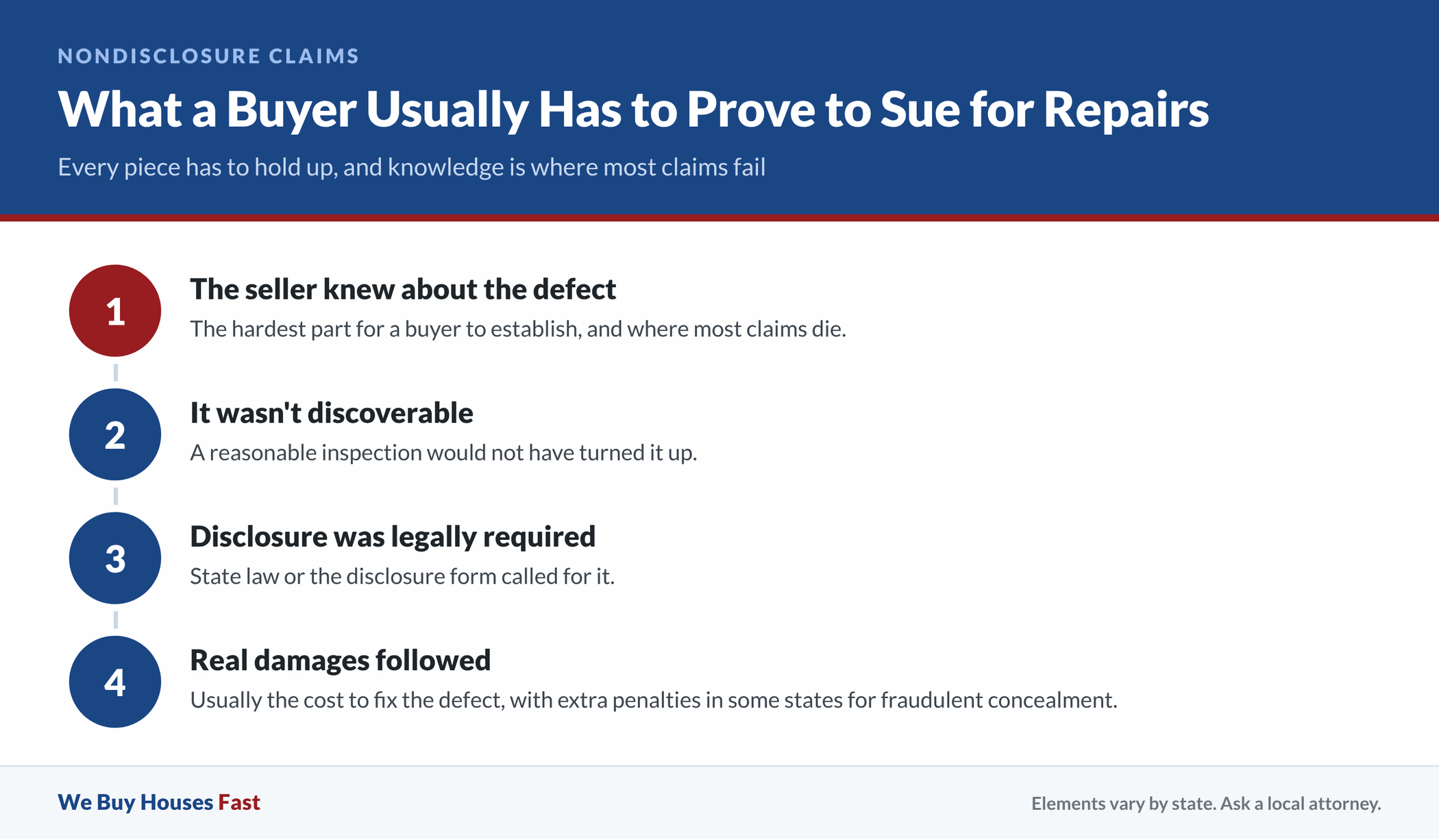
A buyer usually has to establish that the seller knew about the defect, that it wasn’t discoverable through reasonable inspection, that disclosure was legally required, and that real damages followed. New Jersey courts have framed the elements around a deliberate failure to disclose a latent defect that wasn’t observable, with the buyer reasonably relying on the seller’s silence. Knowledge is the hard part to establish, and it’s where most of these claims die.
New flooring laid over rotted subfloor, cosmetic repairs masking water intrusion, buried prior reports: those can support punitive damages on top of the cost of repairs. Painting over a stain to sell a house is the kind of decision that follows a seller for years.
Before closing, a buyer might rescind the contract where state law allows it or negotiate a price reduction to cover newly discovered repairs. After closing, the realistic path is a lawsuit for damages, usually the cost of the repairs. Some states add extra penalties for fraudulent concealment.
Buyers who sue over $4,000 in repairs rarely come out ahead after legal fees, and smart attorneys tell them so.
Should you worry? If you filled out your disclosure honestly and kept your documents, no. Sellers who disclosed thoroughly and sold as-is almost never face legal action, and the ones who do usually win.
How Does a Home Warranty Cover Repairs After Closing?
A seller I worked with had a furnace die eleven days before the sale closed, in a house that had already been under contract twice. Her listing warranty covered the furnace repairs. The sale held together, and the plan rolled to her buyer at settlement.
Seller’s coverage protects a listed home’s major systems and appliances from listing day through closing. It then usually converts into a full one-year warranty for the buyer, paid at settlement. The listing phase runs up to 180 days or until closing, whichever comes first.
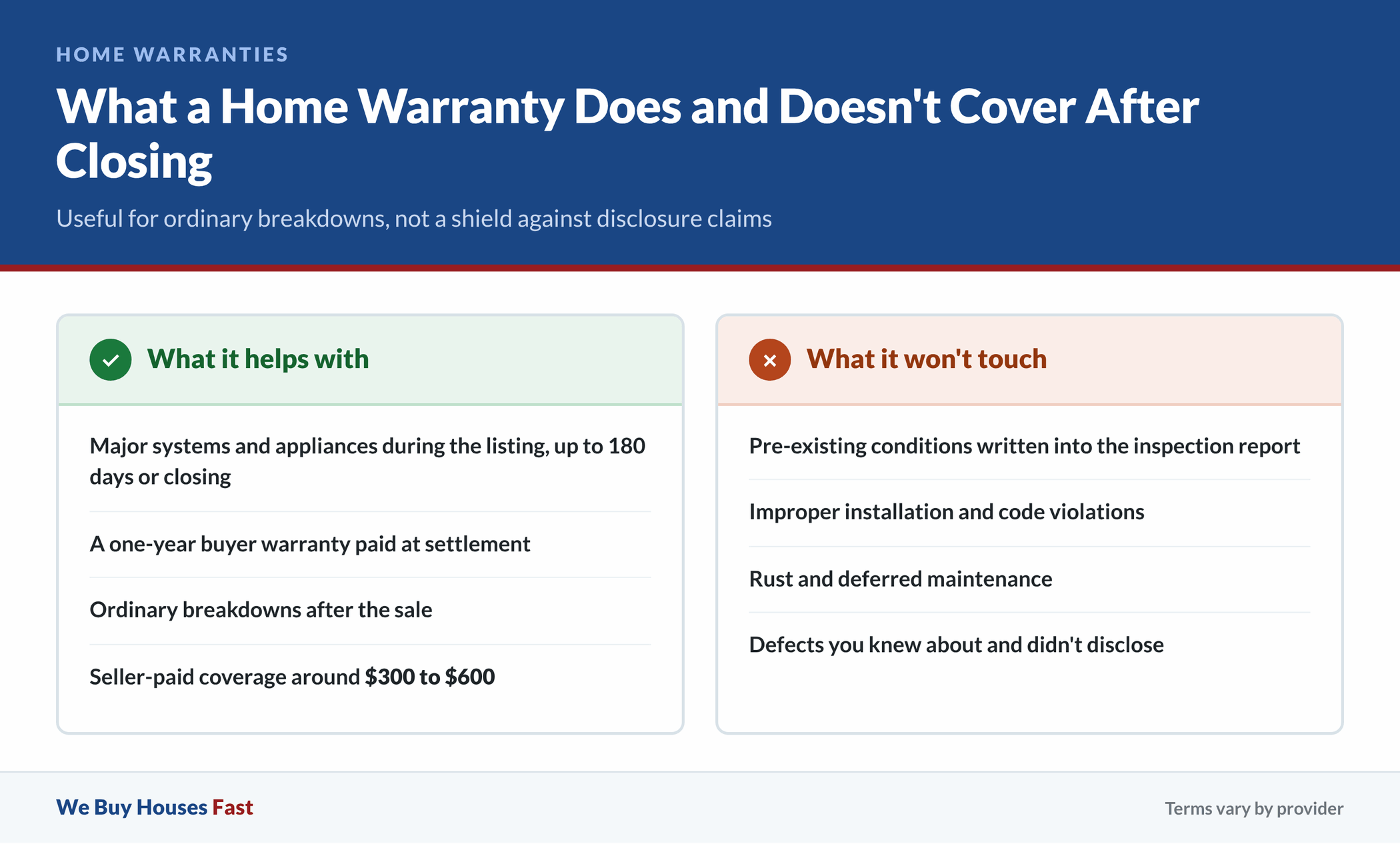
Pre-existing conditions are almost always excluded, along with improper installation, code violations, rust, and deferred maintenance. Claims on a 22-year-old furnace nobody ever serviced may get denied outright. Warranties will cover a pre-existing condition the inspector missed, but not one written into the inspection report.
Seller-paid buyer coverage runs roughly $300 to $600 and shows up regularly as a negotiated concession. For that money, you buy a buyer a place to call other than your phone. A warranty is not a shield against a disclosure claim, though, and I’d rather sellers understood that going in. If you knew the plumbing was failing and said nothing, handing the buyer a service contract doesn’t undo the nondisclosure. What it does do is absorb the ordinary breakdowns that would otherwise generate an angry phone call.
Some providers sell an enhanced plan that covers unknown pre-existing conditions discovered after closing, which is the closest thing to a clean break a seller can hand over.
What Should You Do When Repairs Are Needed Right After Closing?
Most sales contracts require a buyer to notify the seller of a claimed defect within a specific window, and missing that window can sink an otherwise valid claim. Your contract, not your state statute, typically sets that first deadline.
Silence reads as guilt. Refuse to even discuss a problem and it tends to turn into a demand letter. You can be cooperative without admitting liability.
Your disclosure form, the inspection report, the repair invoices, the addenda: that stack usually answers the question of who owns these repairs in about five minutes.
Splitting $2,000 in plumbing repairs with a buyer you’ll never see again costs less than one attorney consultation, and it makes the whole thing go away.
Sellers already carrying stress have a cleaner route. An heir in Greenville, Texas came to us mid-divorce, splitting her late mother’s estate with a sibling who lived three states away. She didn’t want repairs, showings, or a six-month negotiation about a sagging back porch. What she wanted was the house converted to money and the matter closed, which is a perfectly reasonable thing to want.
Selling as-is to a direct buyer removes nearly all exposure to repairs after closing, since there’s no repair addendum to breach and no promises left dangling. If that’s the kind of clean exit you’re after, We Buy Houses Fast handles these situations regularly.
Frequently Asked Questions
Can a Seller Hand the Buyer Cash at Closing to Cover Repairs?
Not usually as literal cash, but yes as a credit. Most lenders prohibit cash passing directly between parties outside the settlement statement. The standard approach is a seller credit toward closing costs or a lower sale price, both documented on the closing disclosure. Your title company and the buyer’s lender need to approve the structure in advance, since loan programs cap how large a seller credit can be.
How Long After Closing Can a Buyer Come After Me for Repairs?
That depends on your state’s statute of limitations for fraud or breach of contract. The clock sometimes starts when the defect is discovered rather than when you closed. Some sales contracts also set their own shorter notice periods for claims. Your real estate attorney or state real estate commission can tell you the specific window that applies to your transaction.
Does Selling a House As-Is Protect Me From Repair Claims Later?
It helps considerably, but it isn’t absolute. An as-is sale tells the buyer you won’t be fixing anything and shifts the risk of unknown problems to them, which eliminates most disputes before they start. What it doesn’t do is excuse hiding something you knew about, so fill out your disclosure form honestly even when you’re selling in current condition.
What If a Repair I Paid for Before Closing Fails Afterward?
The contractor’s workmanship warranty is your first stop, and most reputable trades stand behind their work for a year or more. Give the buyer the contractor’s contact information and the original invoice, which usually resolves the issue without involving you further. If you promised repairs in the contract and they were never done properly in the first place, that’s a different situation and worth a quick call to an attorney.
Should I Offer a Buyer a Warranty to Avoid Repair Arguments?
For sellers with older systems and no appetite for post-closing phone calls, it’s money well spent. The plan gives the new owner somewhere to turn when something quits in month four, which is when most of these disagreements surface. Just don’t rely on it to cover anything you already knew was broken, since those claims get denied and the conversation comes back to you anyway.
Do I Have to Disclose Repairs I Made Years Ago?
If the form asks, answer it. Disclosure forms in most states ask specifically about past repairs to the roof, foundation, plumbing, and other major systems. A completed repair is generally a good thing to show a buyer. Concealing a prior fix looks far worse than disclosing one, especially if a buyer later finds permits or invoices in county records.
Weighing whether to tackle repairs before listing or just be done with the house? I’m happy to talk it through with you. There’s no pressure and nothing to sign. If listing with an agent turns out to be the better move for your situation, I’ll tell you that too.
Repair Requests and Longer Sale Timelines in North Texas
Homes in Dallas County spent a median of 59 days on the market in September 2026, up from 50 in May, based on FRED’s county housing data. More time on the market gives buyers more time to come back asking for repairs.
Dallas homeowners who’d rather skip the repair addendum can sell the house as-is.
The same option is open to sellers across Texas, whatever shape the house is in.
Worried About Repairs Coming Back After You Sell?
An as-is sale with an honest disclosure is one of the cleanest ways to keep your phone quiet once the house closes. We’ll look at your house in its current condition and walk you through how we got to our number. Contact We Buy Houses Fast or use the form below, and we’ll talk it through.