


Subterranean termites don’t hibernate in a Texas winter. They just move deeper into warm soil, keep chewing, and come back up through a slab crack in February like nothing happened. You can treat in October and still find fresh mud tubes along the pier beam come spring. So it’s no wonder nearly every homeowner with termites on an inspection report asks me: can I sell this house at all, or am I stuck fixing it first?
Can You Sell a House with Termites in Texas?
For years I told sellers that bugs in the walls killed a sale. Turns out I was wrong, and the data on how long Texas homes sit now proves it. A seller with termites and a realistic price isn’t in worse shape than a seller with a 1970s kitchen and a stubborn number.
Nothing in state law stops you from selling a house with termites. There’s no permit, no clearance letter, no treatment mandate before closing, but the law does require honesty about what you know. Texas Property Code § 5.008 makes a seller of a single residential dwelling hand the buyer a written disclosure notice covering known conditions. The statute applies to residential property with no more than one dwelling unit in the state.
Active termites make lenders nervous, especially on government-backed loans. An underwriter sees a wood destroying insect report flagging live activity and the file stalls until somebody pays for treatment. Conventional sales die there, not at the disclosure.
A few years back three siblings in Mesquite inherited their mother’s brick ranch with termites in the garage door framing and a sagging section of subfloor near the laundry. We bought it with the damage exactly as it stood.
Sellers in Texas with termites generally pick one of three paths. They can treat and repair before listing, list as-is on the MLS and accept a smaller buyer pool, or sell directly to someone who buys damaged property. It really comes down to how much cash you have sitting around and how fast you need to be done.
Active Termites vs Past Termite Damage: Does It Matter When Selling?
Mislabel a live colony as old history on your disclosure form and you’ve handed a future buyer a fraud claim.
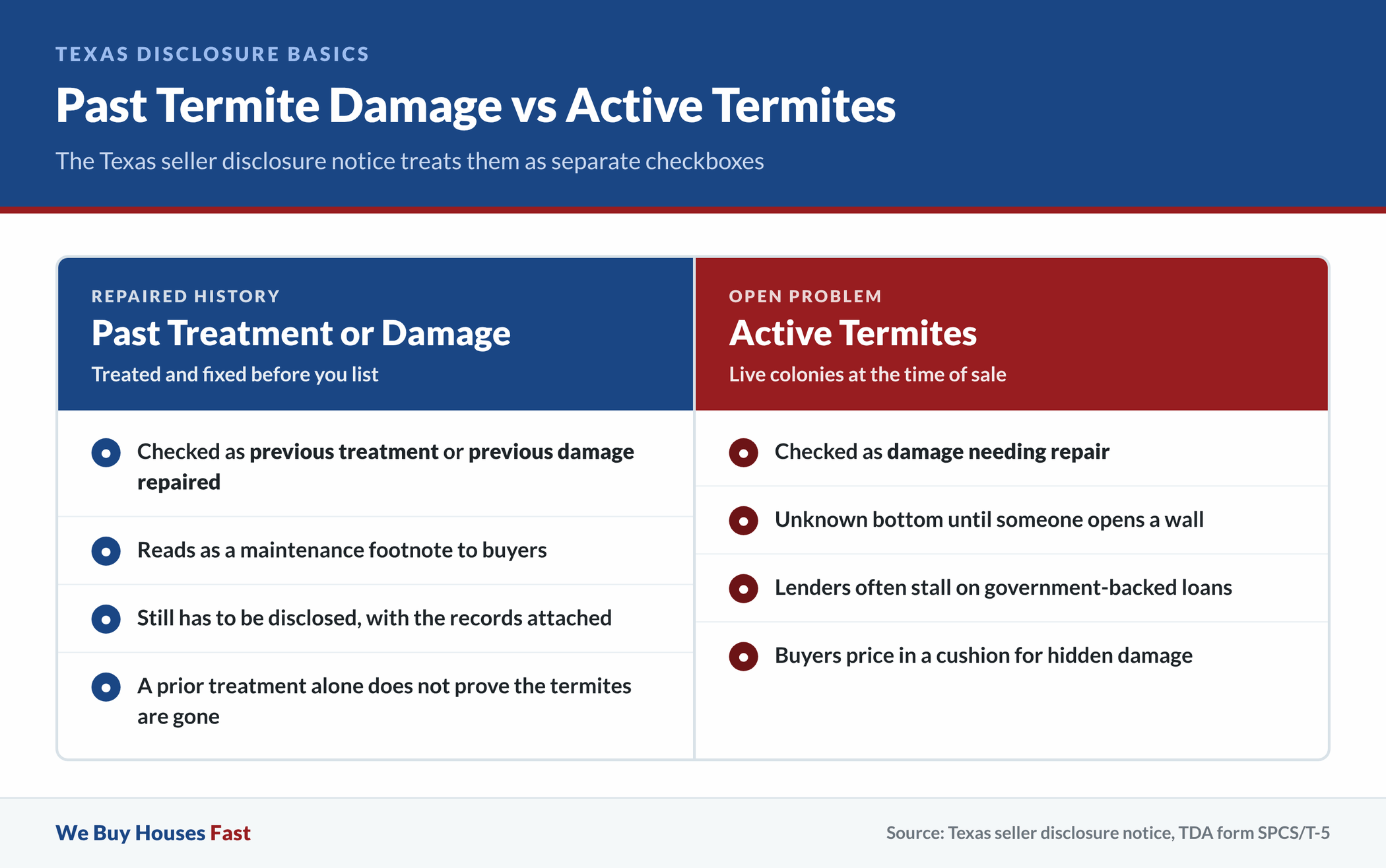
For a reason, the state form separates these. Distinct checkboxes appear on the Texas REALTORS disclosure notice for previous treatment for termites, previous termite or WDI damage repaired, and termite or WDI damage needing repair. A seller who treated in 2019 and fixed the joists checks one box. Someone with live termites checks a different one.
Past damage that’s been repaired is a maintenance footnote. Active termites are an open problem with an unknown bottom, since nobody knows how far the colony traveled until somebody opens a wall. Appraisers and inspectors in Texas treat the two as separate risks, and that’s exactly how we price a house too.
Here’s where sellers trip: evidence of a prior treatment doesn’t prove the termites are gone. An inspector can’t guarantee that a previous pest control company’s work left the pests inactive. It’s printed right on the official Texas report form published by the Texas Department of Agriculture. A receipt from years ago doesn’t mean the house is clear.
Order the report, read what the inspector marked, then fill out your disclosure to match it word for word.
What Are Your Legal Disclosure Requirements for Termite Damage in Texas?
Everything here runs on what the seller knows. Nobody requires you to hire an inspector before listing. You are required to disclose the termites you’re aware of, including the history. Under Texas law, the notice warns sellers that they must disclose all known material facts, defects, needed repairs, and adverse conditions. Failing to do so may result in legal liability.
The notice has to reach the buyer on or before the effective date of the contract. If a contract gets signed without it, the buyer may terminate for any reason within seven days after receiving the notice.

One correction to advice I hear constantly here: an as-is clause does not erase disclosure duty. An as-is clause does not eliminate the seller’s obligations under Texas Property Code § 5.008 or liability for fraud and active concealment. Selling as-is there means you won’t repair the termites. It never means you get to stay quiet about them.
The disclosure form also asks about inspection reports you’ve received. Its current version asks whether, within the last four years, you’ve received written inspection reports from licensed or certified professionals, including termite inspections. People who had a termite inspection done, didn’t like it, and filed it in a drawer are often surprised by that one.
How Termite Damage Affects Home Value in Texas
A widow in Pasadena called me about her late husband’s workshop, where termites had turned two wall studs into something you could push a screwdriver through.
Her situation is the common one. Termites rarely destroy a Texas house; they destroy the seller’s negotiating position.
Value loss tracks three things: where the termites ate, whether they’re still eating, and what the buyer’s lender does with the report. Termites in the trim near a flowerbed barely move an appraisal. Damage in a load bearing beam is a different animal, and in Texas the next step there is an engineer, not a pest quote. When damaged wood shows up in a structural location, the evaluation belongs to a Texas-licensed professional engineer rather than a larger treatment estimate.
Market conditions set the rest. Texas carried a median sale price of $354,970 in October 2026, down 1.12 percent year over year, per Houzeo’s Texas market data. Homes sat a median of 80 days on market. Soft markets punish flawed houses harder than hot ones do. Right now, local buyers have options, and a termite disclosure gives them leverage they didn’t have in 2021.
What termites reached determines whether repair estimates in Texas stay cheap or spiral. Structural repairs from termite damage run into the thousands, and the bill climbs fast once beams or load-bearing walls are involved. They deduct the estimate plus a cushion for whatever the walls are hiding, which is why a $6,000 repair often costs a seller $15,000 in price.
What Determines the Offer Price When a Texas House Has Termite Damage?
Figure out what the house is worth repaired, in its actual Texas submarket, before anything else. A bungalow in Oak Cliff and a similar square footage in Killeen don’t share an after-repair value, so the comps have to be tight. From there, subtract what it costs to get rid of the termites, subtract the structural work the termites made necessary, and subtract every other deferred item the house has collected.

Termites in a pier and beam crawlspace in the Heights are cheaper to reach than termites under a post-tension slab in Plano, where treatment means drilling through concrete.
Treatment itself is the smaller line item. In Dallas, termite treatment ranges from $250 to $2,000, with an average near $650. Dallas-Fort Worth sits in a heavy pressure zone, because eastern subterranean termites stay active year-round in North Texas soils, according to this 2026 Dallas pricing guide.
Then there’s the clock. Dallas County homes spent a median of 59 days on the market in September 2026, per FRED’s Dallas County housing data. Add option period, financing, and closing to that, and a traditional Texas sale with termites can run four months. Every month of taxes, insurance, and utilities comes out of your net.
A good cash offer on a termite-damaged Texas house should show you the math, not just the number. Teams like We Buy Houses Fast will walk through repair assumptions line by line, so push back on any line that looks padded.
Do You Have to Fix Termite Damage Before Selling a House in Texas?
Call a pest company, get the termites treated, patch the wood, list clean.
No Texas statute requires repair before sale. The pressure comes from lenders and from buyers using the report as a bargaining chip.
Fixing first only really makes sense in a narrow set of cases: the termites hit one contained area, you have cash that isn’t earmarked for anything else, and your timeline has slack. Under those conditions, repair usually returns more than it costs, because a clean report widens your buyer pool to every financed buyer in Texas.
The moment the scope is unknown, fixing first stops making sense. I’ve watched sellers start a $4,000 termite repair and end up $20,000 deep because the wood kept going. All of that risk sits on the seller.
You spend real money, you still disclose termites, and the buyer still discounts you.
There’s also a timing problem specific to the state right now. Texas homes are taking longer to sell than the national pace, according to the Home Buying Institute’s Texas market tracker. Add repair time ahead of that and you’re carrying the house a long while. Ask yourself: do you have six months of patience and a repair budget with slack in it?
How to Sell a House with Termite Damage in Texas Without Repairs
Four pages plus a diagram. That’s the Texas Official Wood Destroying Insect Report, form SPCS/T-5, and it’s the document that governs these conversations in every Texas transaction. It’s regulated by the Texas Department of Agriculture through its Structural Pest Control Service, not by TREC. Only a certified applicator or technician licensed in the termite control category can complete it.
Selling with termites unrepaired works through three channels in Texas.
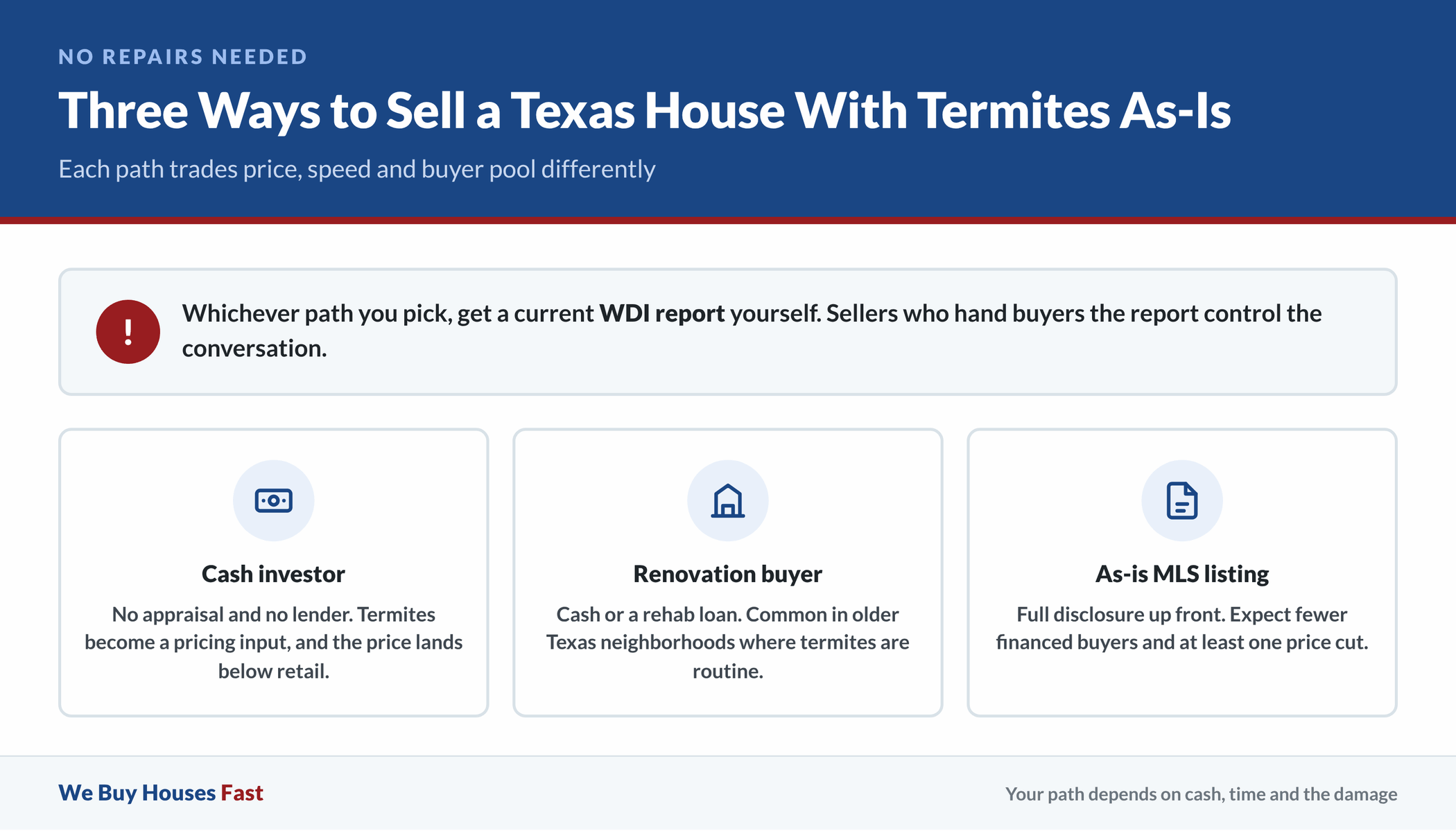
Cash investors are the first. We underwrite damage, we don’t need an appraisal, and termites are a pricing input rather than a reason to walk. Our price lands below retail, because the repair risk transfers to us.
The second channel is a renovation-minded buyer paying cash or using a rehab loan. These buyers exist across Texas, particularly in older neighborhoods where termites are routine.
Third, list the house with termites as-is on the MLS and disclose everything up front. You’ll lose financed buyers whose lenders balk. With price cuts common across Texas right now, you’ll likely cut price at least once.
One thing worth doing even if you repair nothing: get the WDI report yourself. Sellers who hand buyers a current report control the narrative. That’s a pattern I’ve seen hold across hundreds of houses we’ve bought in Texas, and it costs very little to flip in your favor.
Can You Sell a House with Termite Damage and Still Close Fast in Texas?
A Texas rental with termites in the window framing, two months of unpaid rent, and a tenant who stopped answering the phone. Nineteen days later it closed and the owner was out.
Speed is where as-is sales earn their discount. Without an appraisal, without a lender, and without a repair negotiation, a Texas closing comes down to title work and a funding date.
What slows these sales down is almost never the termites. It’s an unreleased lien, a probate that never finished, or an heir in another state who won’t sign. Clear those early and the termites are a footnote.
Put the two timelines side by side. Treat, repair, list, wait out the market median, survive the option period, then wait on underwriting. Or disclose the termites, sign, and close inside a month. The gap in Texas is usually three to four months of carrying costs. In my experience buying houses, those costs are real money most sellers forget to subtract from the higher retail price they’re chasing.
An heir in Temple reached out about a brick duplex she’d never wanted. Termites in the back unit’s door frame were the last straw; she signed on a Thursday and never set foot in the place again.
Plenty of Texas sellers with termites in the walls don’t need top dollar. They need out, cleanly, with the disclosure handled right and no repair bills.
Frequently Asked Questions
How Long Does It Take for Termites to Destroy a House?
Not as fast as the horror stories suggest, but faster in Texas than in cooler states, since our subterranean colonies stay active nearly year-round. Meaningful structural damage usually takes several years of uninterrupted feeding, not months. The danger is that termites work inside wood where nobody looks, so a colony can run for a long stretch before anyone notices. A house that’s been empty for years is where I see the worst of it.
What Does Termite Treatment Cost in Texas?
It depends heavily on your foundation type, your home’s perimeter, and which species you’re up against. Liquid barrier work on a slab home in the Dallas area generally lands in the mid hundreds to low thousands. Gulf Coast properties facing Formosan termites run higher because the protocol is more involved. Bait station systems cost more up front and add an annual monitoring fee. Get two or three quotes from companies licensed through the state’s Structural Pest Control Service before you commit.
Is It a Bad Idea to Buy a House That’s Been Treated for Termites?
No, and I’d argue a treated house is often safer than an untreated one, because somebody already went looking for termites. A documented treatment with a transferable warranty is a selling point in Texas, not a red flag. What you want to see is the paperwork: who treated it, when, what they did, and whether the bond is still active and transferable to you. A verbal “oh, that was handled years ago” is worth nothing.
Will a Buyer’s Lender Refuse the Loan If the Inspection Finds Active Termites?
Often, yes, on government-backed financing in particular. Underwriters typically want live activity treated and the report updated before they’ll fund, which puts the seller in a corner mid-contract. That’s the main reason Texas homes with termites gravitate toward cash buyers. Conventional lenders vary, so your buyer’s loan officer is the one to ask early rather than at the end of the option period.
Do I Have to Disclose Termites If They Were Treated and the House Looks Fine Now?
Yes. The state’s disclosure notice asks separately about previous treatment and previous damage, so a history gets reported even when the current condition is clean. Leaving it blank to keep the form tidy is how sellers end up in litigation after closing. Checking the box and attaching the treatment records costs you almost nothing and protects you completely.
Can I Sell a Termite-Damaged House in Texas If It’s in Probate?
You can, though the estate’s authority to sell has to be in order first. An independent executor with letters testamentary can usually move at normal speed, while a dependent administration may need court approval. The termites don’t complicate the probate side at all; they just shape who’s willing to buy. Your probate attorney can tell you exactly where your case stands before you start getting offers.
If you’re sitting on a Texas house with termites and you’re not sure which path makes sense, we’re happy to look at it with you. You’ll get a straight answer on what we think it’s worth as-is. No repairs, no cleanout, no pressure either way. You can reach out through We Buy Houses Fast and we’ll talk it through. If listing turns out to be the better move for your situation, we’ll tell you that too.
How Termite Houses Fare in North Texas Right Now
Dallas County’s median listing price was $383,575 in September 2026, based on Realtor.com data published by FRED. Buyers shopping in that range have plenty of clean houses to pick from. A house with termites lands at the back of that line, and Dallas homeowners feel it first.
That’s why more sellers across Texas are looking at an as-is sale before they spend money on repairs.
Get an Honest Look at Your Termite House
If termites showed up on your inspection report, you don’t have to fix them before you sell. We’ll look at the house as it stands, show you how we got to our number, and tell you if listing makes more sense. Reach out to We Buy Houses Fast or fill out the form below to get started.