
The appraiser had flagged a section of rotted fascia board and a water heater with no drain pan. Two small items like that stalled a sale that was ready to close. Appraisal required repairs tend to show up in Texas this way: late, small, and loud. I’ve bought houses across this state for years, and the pattern holds almost every time.
What Triggers Appraisal Required Repairs in Texas Home Sales?
One appraiser’s trip into a crawlspace can freeze a file over a cracked sewer line and a missing handrail.
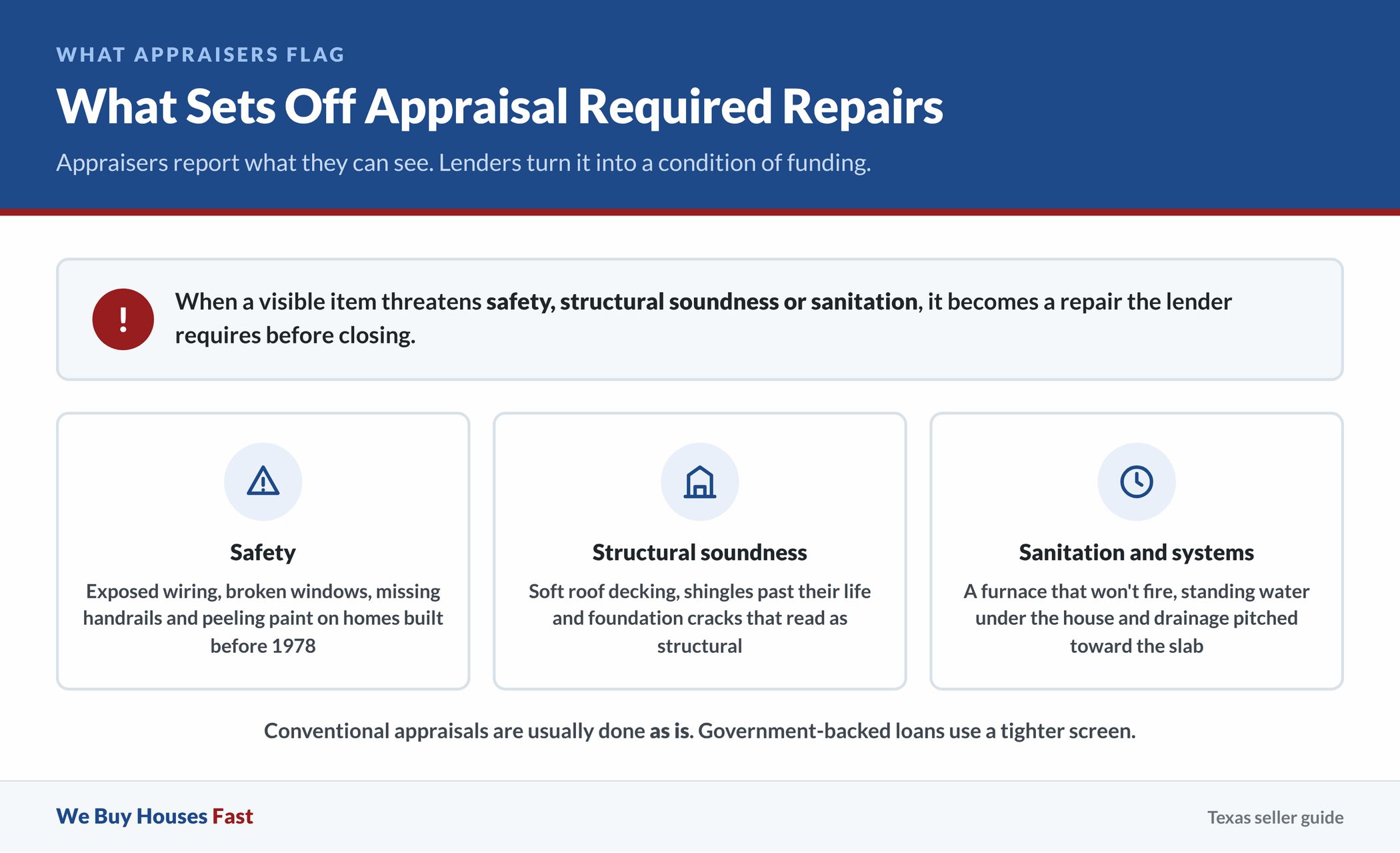
An appraiser isn’t crawling attics with a flashlight looking for trouble. They do have to report what’s visible, though. When something they see threatens safety or soundness, the lender turns that note into a condition of funding. That’s how appraisal required repairs work in Texas sales.
What sets them off here tends to cluster. Soft roof decking, shingles past their life and peeling paint on anything built before 1978 top the list. Exposed wiring and broken windows show up too, along with a furnace that won’t fire or standing water under the house. Our shifting soil adds its own set: foundation cracks that read as structural, not cosmetic. In Houston and along the Gulf Coast, appraisers also flag drainage that pitches toward the slab.
It stings, because the house has been fine for fifteen years.
Early last year I bought from a longtime landlord in Mesquite who was three months behind on the mortgage with an auction date already posted. His tenant had moved out and left a window unit propped in a broken frame, plus a garage full of paint cans. He didn’t have forty days to argue with an appraiser about them, and we closed before the sale date.
Condition isn’t always the trigger, either. Conventional appraisals in Texas often come back “as is” when the only problems are minor wear and deferred upkeep. Anything that hits safety, soundness or structural integrity has to be fixed first. Government-backed loans use a tighter screen, so the same house can sail through one file and get a repair list on the next.
Who Pays for Appraisal Required Repairs, Buyer or Seller?
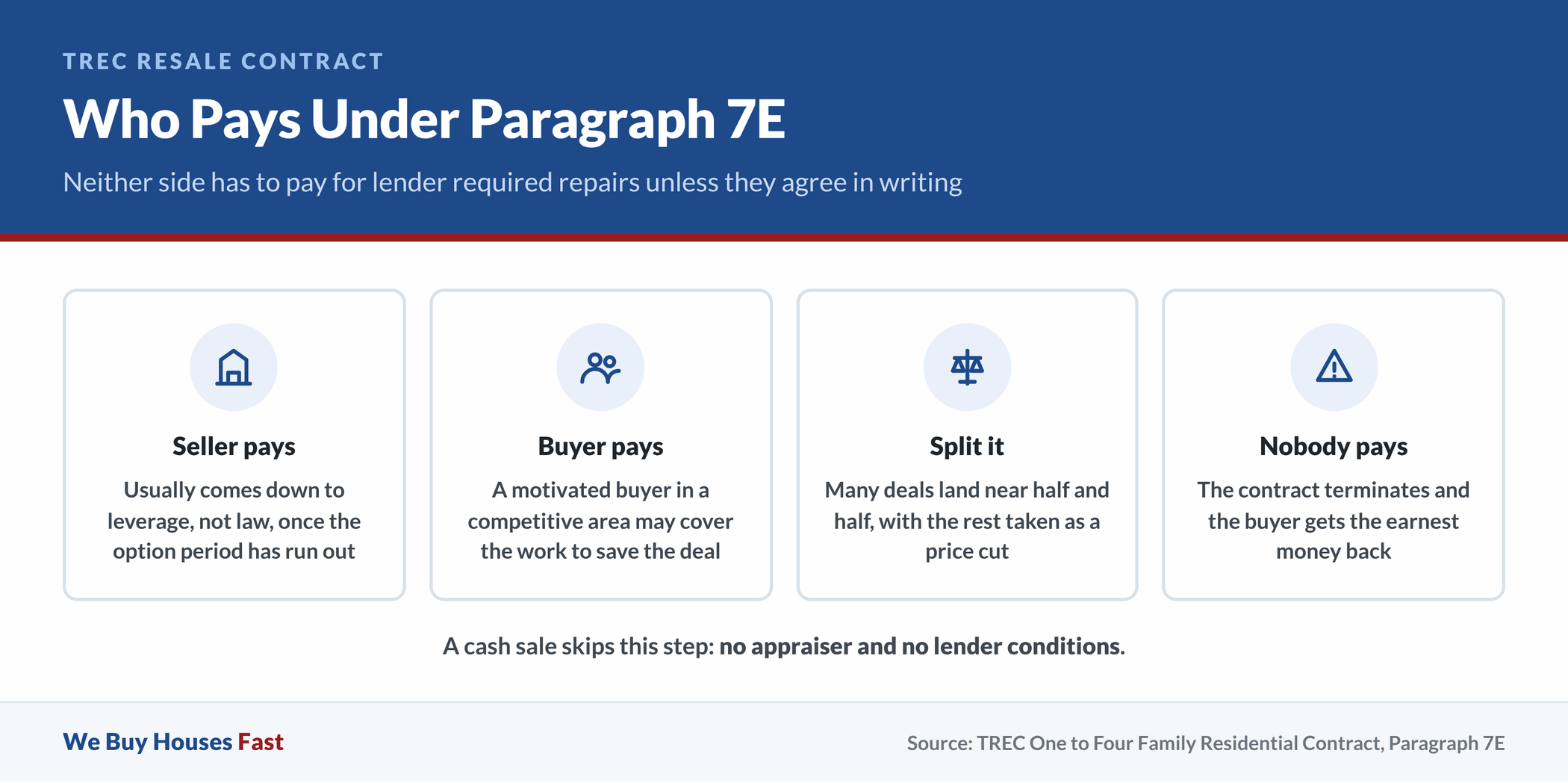
Under Paragraph 7E of the standard Texas resale contract, nobody is on the hook by default. TREC form 20-19, the One to Four Family Residential Contract (Resale), says neither party has to pay for lender required repairs unless they agree otherwise in writing.
So the answer comes down to leverage, not law.
Think about where you stand when the repair list lands. Your option period ended weeks ago, and your buyer has already paid for the appraisal and inspections. If nobody agrees to fund the work, the contract terminates and the buyer gets their earnest money back. You’re relisting with a documented repair list and a stale listing date.
Buyers do pay sometimes. An eager buyer in a hot pocket of Frisco or The Woodlands may cover the work to save the sale. Any buyer-funded work before closing still needs your written OK, since it’s your house until it closes, and the lender has to accept it.
Plenty of Texas sales I’ve watched land at roughly half-and-half, with the rest handled as a price cut instead of actual work.
I’d push back on agents who tell sellers to refuse on principle because the contract says they can. That doesn’t hand you a new buyer. Realtor.com figures on FRED show Texas listings sat a median 66 days in September 2026, so restarting is expensive. Sellers working with We Buy Houses Fast skip this negotiation altogether, since a cash sale has no appraiser and no lender conditions.
What Dollar Limits Apply to Appraisal Required Repairs in Texas?
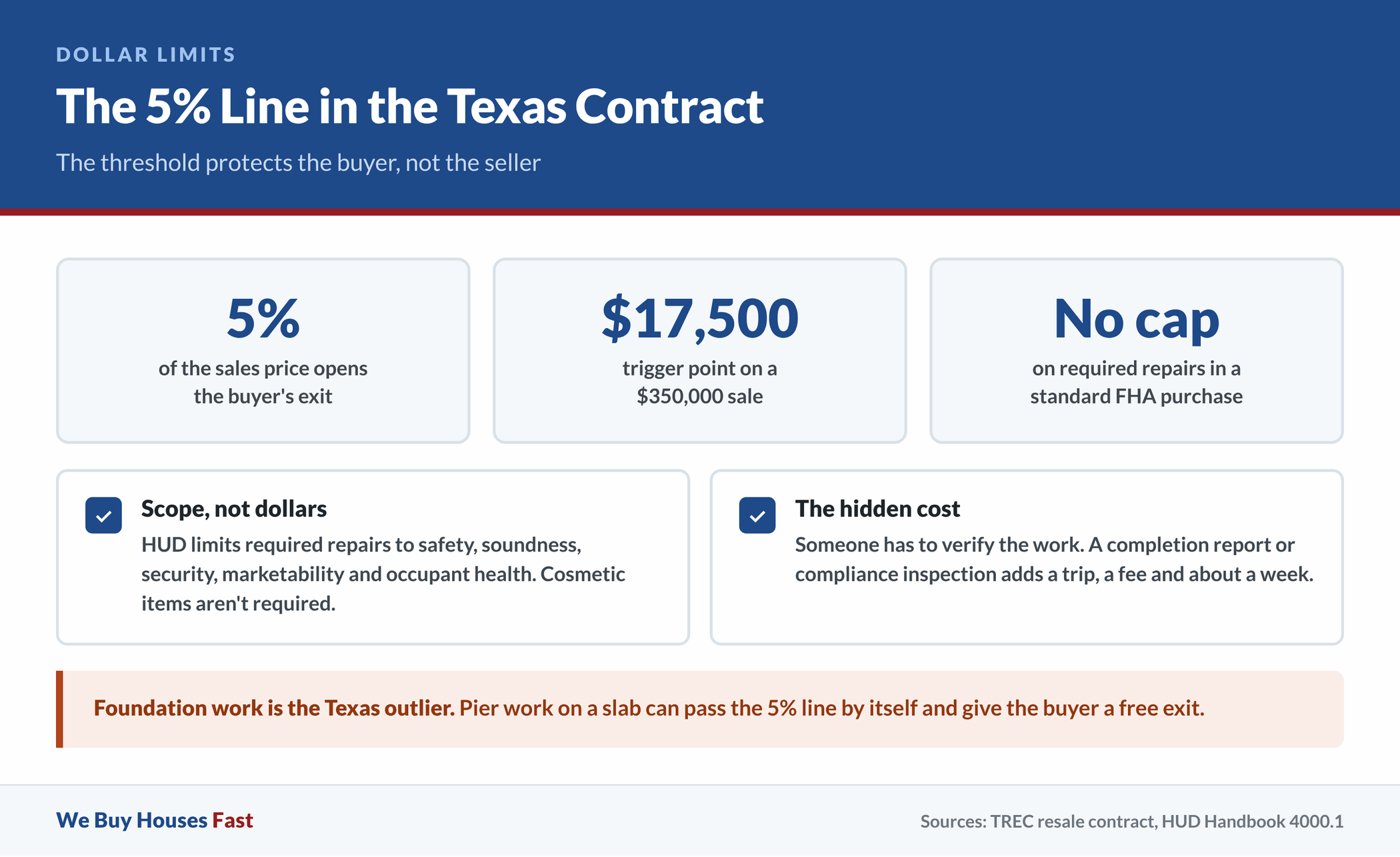
Many sellers assume lenders cap repair demands at some small figure. TREC’s contract does contain a threshold, but it protects the buyer, not you. When lender required repairs and treatments exceed 5% of the sales price, the buyer may terminate and recover the earnest money.
Run that on a Texas house. On a $350,000 sale, the buyer’s escape hatch opens at $17,500 of required work. Below that number, the threshold doesn’t help them, though the contract still ends if nobody agrees to pay. Above it, they can walk away with their earnest money no matter what you offer.
On FHA files, HUD’s handbook defines required repairs by what they protect. The list covers fixes that keep the house safe, secure and sound, keep it sellable and protect the health of whoever lives there. Cosmetic items and normal wear get noted in the appraisal, and the handbook doesn’t make you fix them.
The re-inspection and the calendar are where the real cost of appraisal required repairs hides. Someone has to verify the work. On an FHA loan, the appraiser or an inspector documents it in a follow-up inspection, often on HUD’s Compliance Inspection Report. Each check adds a fee and more time on the calendar.
Foundation work is the Texas outlier. A structural engineer’s letter plus pier work on a Bexar County slab can blow past that threshold by itself, which hands your buyer a free exit.
I keep a rough rule after years of this. Whatever a contractor quotes for those repairs, add a third for the second thing they find once the wall is open.
How Do FHA, USDA, and VA Loans Change Appraisal Repair Rules?
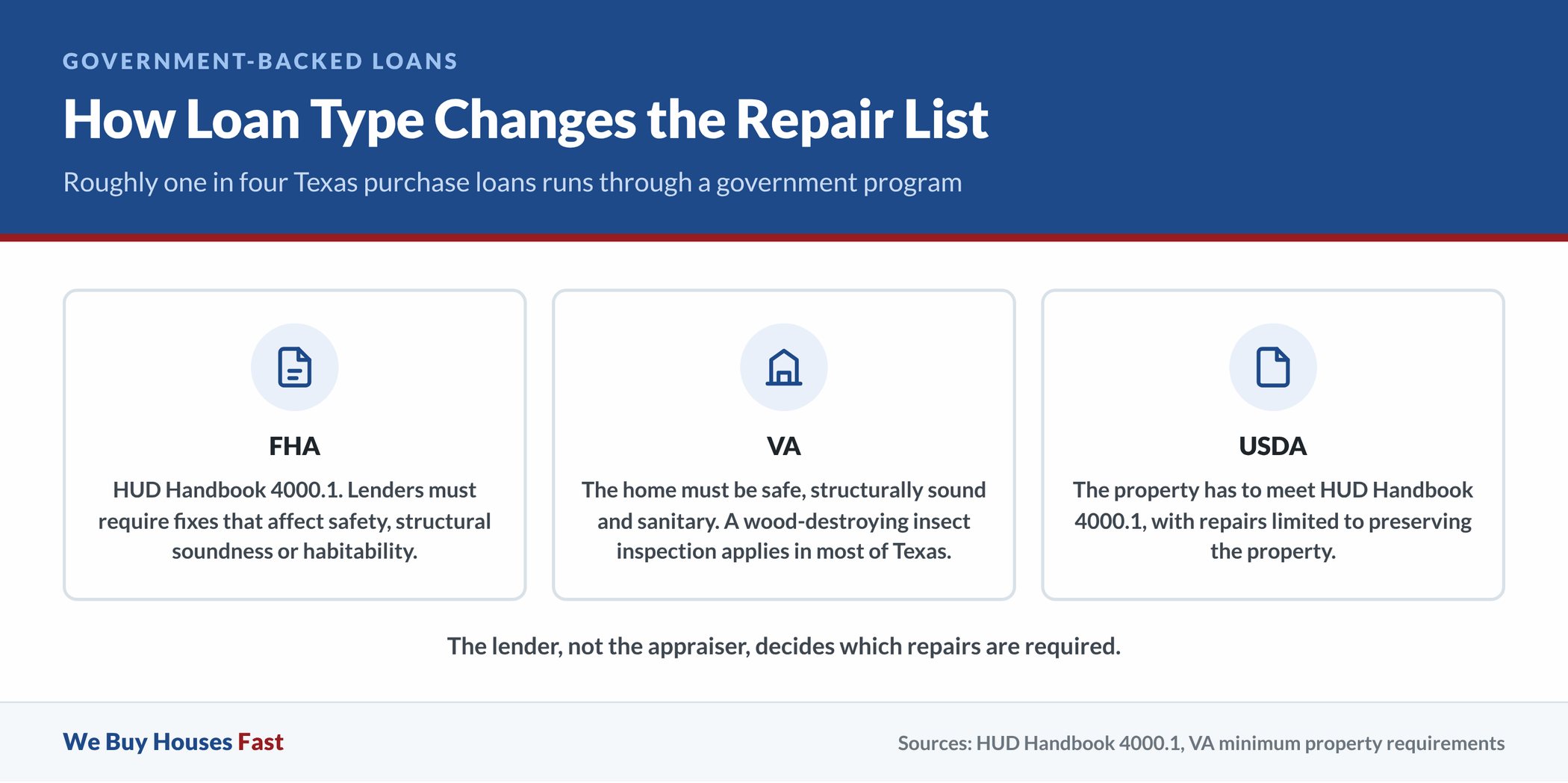
Government-backed files behave nothing like conventional ones.
FHA follows HUD Handbook 4000.1, so the property has to meet HUD’s standards for safety, security and soundness before the loan closes. In Texas, appraisal required repairs on an FHA file usually mean dead utilities, roof damage and exposed wiring. Chipping paint on pre-1978 homes is another regular. Plenty of homes in inner-loop Houston and East Dallas were built before then.
VA files have their own standard. The home must be safe, structurally sound, and sanitary before VA guarantees the loan. Texas adds termites. VA’s regional loan center requires wood-destroying insect information, in practice a pest inspection report, on every Texas property. Any sign of infestation or damage gets a closer look.
Who decides, though? Not the appraiser. HUD says the lender determines which repairs are required, whatever the appraiser suggests. Both HUD’s handbook and VA’s minimum property requirements chapter are online if you want the full standard.
USDA files, which you’ll see in rural areas around towns like Lubbock, Tyler, and Waco, borrow the FHA standard. An existing home has to meet HUD Handbook 4000.1, or meet it once the required repairs are done.
When your buyer is using government financing, assume repairs are coming and price accordingly.
How Do TREC Addenda Affect Appraisal Repair Negotiations?
Plenty of sellers treat the financing addendum as the buyer’s paperwork. That addendum decides whether your buyer can walk and keep their money.
The Third Party Financing Addendum ties property approval to the lender’s underwriting, appraisal and required repairs included. If the lender rejects the house after the appraisal, the buyer can terminate on or before the third day before closing. They give you notice plus the lender’s written reason, and they get their earnest money back. So repairs on a Texas sale aren’t just a cost question. They’re a termination risk.
VA loans add another layer. If the price tops VA’s reasonable value, the buyer doesn’t have to close or forfeit earnest money, though they can still go ahead.
Once you agree to do the work, Paragraph 7F takes over. You must finish all agreed repairs and treatments before closing and get any required permits. Someone licensed for that work has to do it, or someone commercially engaged in the trade when no license applies.
Put every agreement about appraisal required repairs in Texas in a written amendment. Where the lender allows it, offer a price cut instead of repairs. Cap your dollar exposure in writing, and ask for an extension in the same amendment where you agree to the work. TREC posts its current forms on its site, and reading Paragraph 7 before you list beats reading it in a panic.
What Happens If a Seller Refuses to Make Appraisal Repairs?
Sometimes sellers assume the buyer needs the sale more than they do. I watched a seller in Killeen dig in over a roof repair on a VA sale, convinced the buyer would blink. The buyer terminated on a Friday, and the house sat another two months before a weaker offer came in.
Refusal is legal. It’s just rarely free. When neither side funds the work on appraisal required repairs, the Texas contract terminates and the buyer’s earnest money goes home with them.
Then the disclosure problem arrives. You now know about conditions the appraisal documented. Section 5.008 of the Texas Property Code has most sellers of a single-family home give the buyer a written Seller’s Disclosure Notice. You fill it out to the best of your knowledge. The next buyer’s appraiser will probably find the same roof and the same handrail anyway.
Is refusing ever the right call? Yes, in two situations. When the lender asks for a repair the program doesn’t require, push back with the handbook language. And when the house truly belongs in the as-is market, stop chasing buyers with loans.
That second path is where I spend my days. A cash sale takes the appraiser out of the equation, and appraisal required repairs leave with it. We Buy Houses Fast buys Texas houses in whatever condition they’re in, roof and foundation included.
Timing matters here too. HAR reported that the Houston median single-family price fell 3% to $320,000 in October 2026, and homes took an average 59 days to sell. A failed sale in a softening market costs more than the repair almost always did.
How Can Sellers Avoid Appraisal Required Repairs Before Listing?
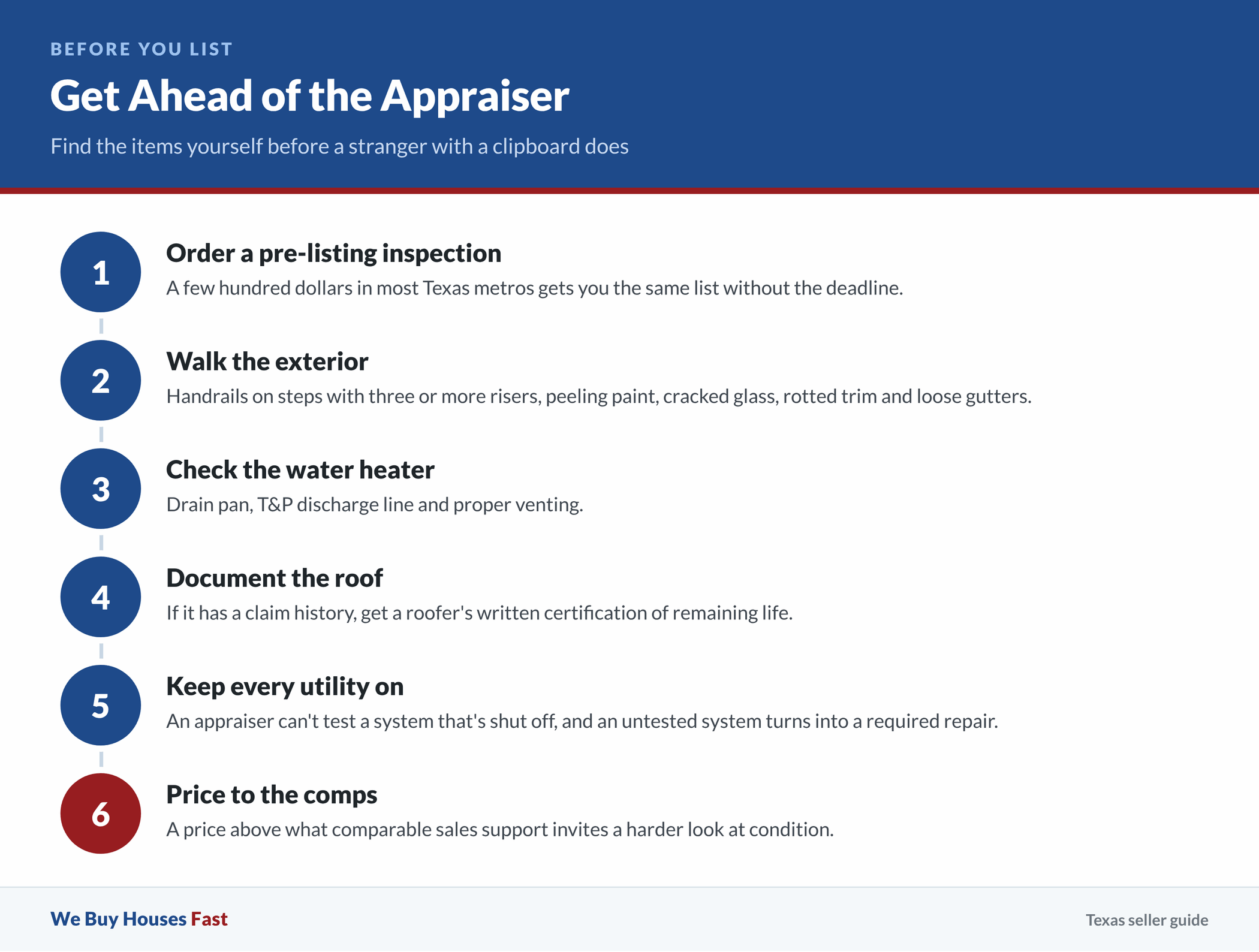
The cheapest fix is finding these items yourself, ahead of a stranger with a clipboard. A pre-listing inspection is a small bill next to a failed sale. You’ll get the same list the appraiser would, without the deadline or a buyer watching you scramble.
Walk the exterior with appraiser eyes. Look for missing handrails on steps, peeling paint and cracked glass. Rotted trim, loose gutters and soil mounded against siding get written up too. Then open the closet and check the water heater’s drain pan, T&P discharge line, and venting.
In my experience, roofs and paint drive most of the appraisal required repairs I see in Texas. After hail hits Tarrant County or the Hill Country, appraisers look harder at shingles. If your roof has a claim history, get a roofer’s written certification of remaining life and hand it to the appraiser at the door.
Keep every utility on. An appraiser can’t test a furnace with the gas off, and an untested system becomes a required repair by default.
Price it right, too. Dallas homes hit a median $460,680 for the three months ending October 2026, up 7.8% from a year earlier. A house priced above what comparable sales support invites a harder look at condition.
Add it up honestly. If your repair total tops the discount on a cash offer for the house as it sits, the repair path isn’t winning.
What Do Houston-area Appraisal Repair Requirements Look Like?
Own an older house inside Loop 610, and you should expect drainage and foundation questions. Houston appraisers see them constantly. Clay soils swell and shrink, pier-and-beam homes in the Heights and Oak Forest develop sloped floors, and flood-zone homes draw a hard look at elevation and crawlspace moisture. Appraisal required repairs here often involve wood rot at the sill, since humidity and termites work together.
Termites thrive in Southeast Texas humidity. With the VA termite rule above, sellers in Katy, Spring, and Pearland who take a VA offer should plan on treatment. Appraisers also flag patchy roof work from a prior claim, like mismatched shingles or a patched valley.
Older neighborhoods bring paint issues. Garden Oaks, Riverside Terrace, and much of Pasadena were built well before 1978, so defective paint comes up on FHA and VA files.
A divorcing owner in Sugar Land called me wanting one clean sale, not a repair negotiation with two lawyers reading every amendment. We bought it as-is on their timeline, with no appraiser and no repair list.
HAR’s October report put Houston’s single-family supply at its highest level in 14 years. When a sale falls apart over a repair list, you’re carrying the house while the next buyer shops a long list of competing homes.
Frequently Asked Questions About Appraisal Required Repairs in Texas
How Much Can an Appraised Value Rise Year Over Year in Texas?
No law caps how much an appraisal for a mortgage can increase; market value is market value, and comparable sales drive it. You may be thinking of the homestead cap on property tax assessments, which is a separate county appraisal district process and unrelated to lender appraisals. Your county appraisal district can explain the assessment limit that applies to your homestead. A lender’s appraiser answers only to recent sales and property condition.
Does Texas Have a Right to Repair Law for Home Sellers?
Texas has no statute forcing a seller to repair anything before a sale. What you do have is a disclosure duty on known material defects, plus whatever obligations you voluntarily accept in the contract. The construction-defect notice requirements that apply to builders are a different body of law and don’t reach ordinary resale sellers. For appraisal required repairs, your obligation comes from the amendment you sign, not from state law.
Can I Sell a Texas House Without Fixing Appraisal Required Repairs?
You can. Selling to a cash buyer removes the lender, the appraiser, and the repair list from the transaction. You’ll typically net less than a fully repaired retail sale. The honest comparison is your cash offer against the retail price minus repairs, carrying costs and commissions, with the risk of a failed sale on top. Plenty of Texas sellers run that math and choose certainty.
If you’re staring down a repair list and trying to decide whether it’s worth fixing or simpler to sell as-is, we’re happy to talk it through with you. Walk us through the house, tell us what the appraiser flagged, and we’ll give you a straight read on both paths. No pressure, no obligation, and no hard feelings if you decide the repairs make more sense.
Get a Straight Read on Your Repair List
Tell us what the appraiser flagged, and we’ll walk you through both paths: fixing it and listing, or selling it to us as it sits. Reach out to We Buy Houses Fast with questions, or fill out the form below for a no-obligation cash offer.